
Friday, 30 October 2015
MR FAIRNINGTON'S MENAGERIE

Wednesday, 26 August 2015
Dunstanburgh Sketch
 |
| A tiny sketch-about postcard size, done in acrylics. Just an idea for a bigger painting. A sunset scene with the light coming from the left as you get in C17 Dutch masters. |
Saturday, 6 June 2015
CRASTER CHAIN HOME LOW RADAR
Structures and platforms adjacent to the main buildings. I don't think these are normally visible but some vegetation seems to have been cleared as of April 2015 when these were taken.There are basic platforms on the western side of the Heugh and only a little south-west of the main buildings.According to the Derelict Places website they are mostly the bases for Nissen huts.This would presumably be for the staff though local stories have it that Italian POWs lived here.
 |
| Platform visible half way up side of Heugh |

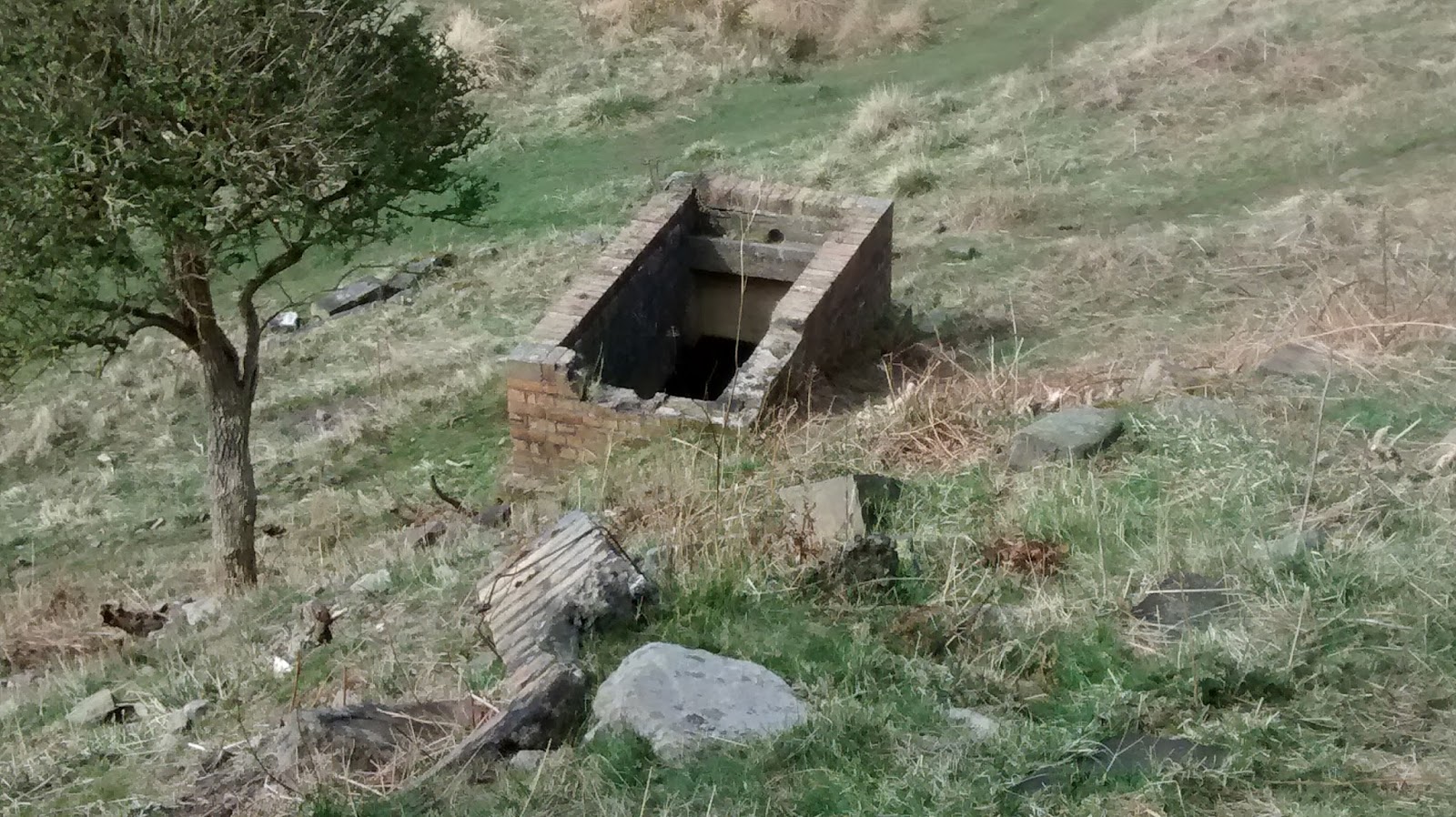

 |
| What appears to be a path-quite steep-marked by stones on Heugh side |

 |
| Platform at top |
THE LILBURN TOWER-AT DUNSTANBURGH
 |
| The Lilburn Tower at Dunstanburgh. Nov 2012 Taken after very heavy rain which caused the northernmostmere to flood. This can be seen lower left of the composition. |
Friday, 22 May 2015
The Guardian of the Sailors' Grave (Tadorne)
 |
| cutting kindly provided by one of Mr Thompson's nephews. |
Thursday, 7 May 2015
BERWICK'S BURRELL
I had a visit to Berwick last week, during the last days of the exhibition, to see the artworks which Sir William Burrell gifted to the town. The other Burrell Collection. I had seen the paintings as a child when they were displayed in the old library.
I knew there would be Crawhalls. That was sufficient reason to go. And there were two watercolours by Arthur Melville*. Now I yield to none in my admiration for Melville and Crawhall.But both artists were represented by second grade work. To see those four pictures by Crawhall was to think that Burrell was giving Berwick less good examples. The Crawhall masterpieces, of which Burrell had many, went to Glasgow.The Daubigny is nothing special and the Gericault drawing-if it is by Gericault is not up to much.
In terms of quality,the best works-showing a good artist working well-were by Boudin, particularly the scene on the River Toques which flows into the sea between Deauville and Trouville, which you can see below.
It is a slightly odd collection, an Opie portrait and a portrait which was once given to Raeburn.And yet another LeNain group. There are several items by well known C19 Dutch artists-very much collected in late C19 Scotland. They are not very exciting examples of their work.
 |
| Boudin; River Touques, Berwick Museum & Art Gallery |
The dramatic and stagey Rembrandtesque landscape by Georges Michel is hard to forget-but then he did churn them out.
The Degas sketch of Russian dancers was an indifferent example from a group of late works. Still it is always good to see a Degas.
Burrell was quite rightly, extremely concerned for the protection of the collection which became the eponymous museum -and expected it to be preserved in a suitably cautious manner. Glasgow has taken legal steps twice to overturn clauses in his will: Firstly because his concerns had led him to stipulate a site at considerable distance from the centre of Glasgow (away from smoky shipyards).The second time, much more recently and frivolously was because Glasgow wants to send items from his collection on loan overseas.They got their way in the end. For more on this controversy see here.
*If you want to see really fine work by Melville then go to Edinburgh later this year for a real treat. Further info about the show at the National Gallery is here
Sunday, 19 April 2015
APPLEBYS IS CLOSING

The end of an era.Appleby's bookshop in Morpeth will soon be closing. It was my first bookshop.I remember one of my first books was Lawrence Durrell's "Bitter Lemons" about Cyprus. I never read anything more by him. I also bought, for 10/6d in 1965 John Rewald's biography of Cezanne which I read very quickly and then followed up with attempts to do Cezanne like watercolours.
This was before the Wallace family took over. In their time the shop seemed to expand a bit-onto the first floor. They eventually brought over container loads of books from the USA so it was a wonderful place to find art catalogues.
This was before the Wallace family took over. In their time the shop seemed to expand a bit-onto the first floor. They eventually brought over container loads of books from the USA so it was a wonderful place to find art catalogues.
On the rare occasions when I bought a new book Appleby's could be much quicker in getting it than any high street chain.
There is now I think only one independent bookshop selling new books in Northumberland.That is 25 miles away in Hexham.Looking North-as I frequently do the next independent is at Newton St Boswells-which is into the Borders past Jedburgh.
Sunday, 19 October 2014
WRECKERS OF NORTHUMBERLAND
 |
| THe Wreckers-J M W Turner |
But then again there were supposedly two kinds of wreckers.The idea of wreckers as people who lure ships to destruction seems to have much less credibility than the idea that folk would take the cargo and anything else they could get from wrecked ships. Just what Turner was intending in this picture is not entirely clear .The group on the seashore appear to be hauling something to land.The temptation to collect something useful must have been considerable and it is likely that country folk regarded this activity as on a par with poaching.
Turner had first visited Dunstanburgh in 1797 and here interprets the scene with considerable freedom. He has the relationship of the main towers to each other but forgets that the keep is not perched over a precipitous drop. He is perfectly correct that there is a considerable drop from the base of the Lilburn tower to the top of the Egyncleugh tower tower-a fact which many artists get wrong.
You can see several of Turner's paintings of Dunstanburgh in David Hill's Turner in the North published by Yale in 1997. Hill illustrates a Dunstanburgh from c 1828 which shows a customs officer arriving to supervise the salvage of a wreck.This watercolour is in the Manchester City Art Gallery.
Monday, 6 October 2014
An Optical Illusion at Dunstanburgh
I often visit Craster and the area round about. It is one of my favourite places. Dunstanburgh interests me from the point of Northumbrian history and as an artist I love the play of light on the castle ruins and the constantly changing colours of the bracken and grass through the seasons.I have explored the area a lot as a landscape painter and from one point up on the heugh you can see an example of a classic optical illusion.

The bent or broken line illusion was discovered in the 1860s by JC Poggendorf a physicist. You can learn more about this illusion here and in this PDF
 |
| Dunstanburgh from the Heugh |
When you look at the horizon in this photo above I believe that you will see that on the right the horizon appears to be somewhat higher than it does on the left of the picture. This isn't really the case as you can see where I have superimposed a grey layer on the second picture with a straight line running along the horizon.
 |
| And another view where the illusion is even more obvious. |
The illusion is presumably caused because our eyes/ brain is disturbed by the mass of the castle in the centre of the picture and cannot, so to speak, join the two parts of the horizon line. On the left there is the steep fall of the land below the Lilburn tower which, I would say, adds to the confusion. The silhouette of the castle itself may be an additional difficulty.
The bent or broken line illusion was discovered in the 1860s by JC Poggendorf a physicist. You can learn more about this illusion here and in this PDF
Tuesday, 22 July 2014
LIME KILNS AT LITTLE MILL
Some of the largest lime kilns in Britain are to be found near the east cost railway at Little Mill in Northumberland. Also to be found are traces of nearby quarrying and a waggonway associated with the site.There are many kilns in Northumberland ranging from small ones on farms to these which obviously operated on a huge scale and no doubt benefited from their nearness to the railway in terms of sales to customers. Part of the site is a nature reserve.The kilns were recently restored.
 |
| One of the flooded quarries-this to the south of the kilns |
 |
| Traces of the waggonway-to the south of the kilns |
 |
| One of the smaller kilns. They are all grouped together. |
 |
| The biggest kiln-has several "ovens" inside. |
 |
| Another view of the main kiln. |
Thursday, 22 May 2014
Hawthorn Paradise
 |
| Near Alnwick 21/5/14
The hawthorn started to come out in Northumberland last week and now there is a wonderful display. Hedgerow after hedgerow is white.
|
Monday, 24 March 2014
BORDER WINTER BY JAMES HOLLAND

This is a tiny collage painting which I made to give an impression of the colours of a winter in the Borders. On some days the land appears more luminous than the sky.
Tuesday, 18 March 2014
THE ALNWICK LIONS
No, that's not the Lions who run the friendly charity bookshop in the town. I refer instead to the lions at the base of the Tenantry Column where many a local child has been taken and photographed by fond parents.Here is one of them, photographed some time in the 50 years or so when there were no railings to protect the lions. I don't think he looks very confident about the experience.

The column is one of the first things you see on entering Alnwick from the south. Everyone knows the supposed stories that the then Duke decided that if the tenantry could subscribe for a column they could logically have their rents raised. But the truth, or otherwise of this is another matter. Part of the intention was to commemorate the Percy Volunteers which had been financed by the second Duke.This was appropriate, considering that the Napoleonic wars had ended only in the previous year of 1815.

It is curious that in his elaborate description of the ceremony of the architectural features and the dedication ceremony for the column the historian of Alnwick, George Tate nowhere mentions the four lions at the base of the structure. They are illustrated rather pathetically in the plate which accompanies his text, but nothing is said about them. Architecturally it is a quality piece of work and the designer was David Stephenson who thirty years before had commenced the building of the remarkable All Saints on Above Newcastle Quayside.
These lions are in fact substantial examples of Coade stone, a commercial product much used in the late C18 and early C19, and the stone of the column itself is from quarries on the Percy estates. But Coade stone is not a stone, it is a form of ceramic and these lions were cast from moulds.Items such as the lions were fired in very largekilns. Coade stone has been described as a species of terracotta. The difference is simply that a combination of finely ground already fired material has been added. These additions include grog, quartz, flint, glass and ball clay. It is in effect a form of stoneware.
On the day of dedication, July 1 1816, a procession left the White Swan Inn. Included were representatives of the tenants, two clergymen and in third place the architect David Stephenson, "with a highly finished silver trowel, ornamented with appropriate devices and inscriptions." The roll of the Percy Volunteers was buried in the foundations "hermetically enclosed in a glass tube."After the ceremony the procession returned whence it came and presumably a good time was had by all.
Descriptive and Historical View of Alnwick: George Tate. I used Frank Graham's reprint of 1973.
 |
| Coade Stone Lion: Alnwick |
The column is one of the first things you see on entering Alnwick from the south. Everyone knows the supposed stories that the then Duke decided that if the tenantry could subscribe for a column they could logically have their rents raised. But the truth, or otherwise of this is another matter. Part of the intention was to commemorate the Percy Volunteers which had been financed by the second Duke.This was appropriate, considering that the Napoleonic wars had ended only in the previous year of 1815.
These lions are in fact substantial examples of Coade stone, a commercial product much used in the late C18 and early C19, and the stone of the column itself is from quarries on the Percy estates. But Coade stone is not a stone, it is a form of ceramic and these lions were cast from moulds.Items such as the lions were fired in very largekilns. Coade stone has been described as a species of terracotta. The difference is simply that a combination of finely ground already fired material has been added. These additions include grog, quartz, flint, glass and ball clay. It is in effect a form of stoneware.
On the day of dedication, July 1 1816, a procession left the White Swan Inn. Included were representatives of the tenants, two clergymen and in third place the architect David Stephenson, "with a highly finished silver trowel, ornamented with appropriate devices and inscriptions." The roll of the Percy Volunteers was buried in the foundations "hermetically enclosed in a glass tube."After the ceremony the procession returned whence it came and presumably a good time was had by all.
Descriptive and Historical View of Alnwick: George Tate. I used Frank Graham's reprint of 1973.
Friday, 14 March 2014
TOYS AND PASTIMES IN 1920s NORTHUMBERLAND
FOOTBALL
When the pig was killed the bladder would be cleaned and then inflated by inserting a pipe stem in the neck of the bladder. When inflated the bladder was wrapped in old woollen socks and was then ready for use, Local farmworkers would play football on summer evenings, sides being made up from boys and men. Some hinds would actually buy a real leather football.
CRICKET
Was never popular. We were such good shots that we saw no point in throwing a ball at three bits of wood.
ROUNDERS
Our teacher tried to get us to play this game but we had little interest. We considered this to be a "lassie's game".
PEASHOOTERS
We called these "Pluffers: and mad them from elderberry branches. The pith was cleaned out with a piece of fencing wire, For ammunition we used the haws from the hawthorn tree. We would eat the fruit and then dry out the stone. We called these "Cat haws".
STILTS
These were made from Tate and Lyle syrup tins. The holes were made in the bottom of the tin and strong string was then threaded through which we held in each hand. We would gallop round the playground or through the village on these pretending we were horses.
We would also make high stilts from old fencing rails and these were useful when scrumping apples. We always envied the Dutch people as we believed that everyone in Holland walked about on stilts.
CATAPULTS
We would look for a "Y" shaped .branch and trim this into shape. For elastic we would cut strips from an old motor tube.The sling or part that held the stone was made from an old boot tongue.
The rubber was attached to the "Y" by by using the leather loops from an old pair of braces. These were effective weapons and we used the to kill rabbits or vermin. Shops in Alnwick actually sold proper catapult elastic.
BOWS AND ARROWS
Young Ash saplings about 4 feet long were made into bows. Arrows were made from shoots of the wild rose or briar, the tips being hardened by charring slowly in a fire. They were quite lethal weapons, capable of killing a rabbit. Our teacher barred us from bringing these to school when she discovered some of us trying to emulate William Tell by trying to shoot at apples balanced on the heads of younger boys.
TOPS
Tops were sometimes called "peeries" and were made from cotton reels, a fine pointed piece of wood being driven through the hole in the reel, The top would be coloured with chalks. Whips were made from tree branches, the string being of strong fisherman's twine. These were eventually used for driving cattle, knots being put in the whip-lash.
MARBLES Glass marbles were obtained from lemonade bottles. When Father was out draining or ditching he would often bring home a lump of yellow clay and we would make our own marbles, baking them in the oven where Mother baked "our daily bread".
ROCKETS
Carbide was used for bicycle lamps in th and came in tins about 12 inches long and 1.5 inches in diameter. Getting an empty tin we would pierce a hole in the end, spit on two pieces of carbide, drop these into the tin then swiftly put the lid on. A match was then held to the hole, igniting the gas and blowing off the lid with a loud bang.
CONKERS
Very seldom played at school. Girls would collect conkers and make them into "Dollies' chairs" by using pins for legs. Pins were used for the back of the chair, interwoven with bright coloured thread.
SOLITAIRE AND DRAUGHTS
Nearly every home possessed a solitaire board and draughts were a popular pastime, particularly on winter nights.
CARDS
We all learned to play Whist, Beggar My Neighbour and many other card games. Happy Families were considered "cissy".
HOOPS
Very popular in summer time and we made these from old bicycle wheels with the spokes removed. The "cleek" for steering and control was made from strong fencing wire. Blacksmiths would make steel hops for 6d but that was a lot of money. Our bicycle hoops were quite noisy but we would bowl them along pretending we were motor cycle racing at the Isle of Man.
These notes were compiled by my father Joe Holland in the 1980s and reflect the toys -home-made or otherwise available in a poor farming community in Northumberland in the 1920s.They were first published in Northumbrian Words and Ways (Geordie,Durham & Northumberland dialect and customs) via the course on this subject at the University of Newcastle Centre for Continuing Education 1987-8.The co-ordinator was Jean Crocker. This material is copyright.
Tuesday, 11 March 2014
THE CORBRIDGE ANGEL
Not many pubs have their signs designed by artists. This one at the well known Angel Inn at Corbridge was designed by Leonard Evetts who was for many years Master of Design at the University of Newcastle. His chief work was in stained glass and all the aspects of church furnishing but he also did a lot of industrial design.This early work is one example.

LORDENSHAWS AS SEEN
Three views of the extensive hill-fort at Lordenshaws on Garleigh Moor, just south of Rothbury, Northumberland.
 |
| From Upper Coquetdale by David Dippie Dixon-looking more towards the Simonsides. |
 |
| A photo of my own from 2011 |
 |
| My own watercolour made from observation on site. |
Monday, 10 March 2014
ISAAC MILBURN-BONESETTER
 |
| Isaac Milburn gravestone |
Milburn also lived at Elsdon,as an innkeeper and at Longframlington before moving to Longhoughton.My information is taken from Smugglers and Poachers at Wallington Hall which was a Frank Graham publiation of 1979.It reprints a substantial article on Milburn's bone-setting from the Newcastle Courant of 28/03/1879.
DUNSTANBURGH MERES
 |
| From the west |
 |
| Lilburn Tower and north mere. |


FELTON 1924
 |
| Felton 1924 |
Subscribe to:
Posts (Atom)