Saturday, 6 June 2015

CRASTER CHAIN HOME LOW RADAR

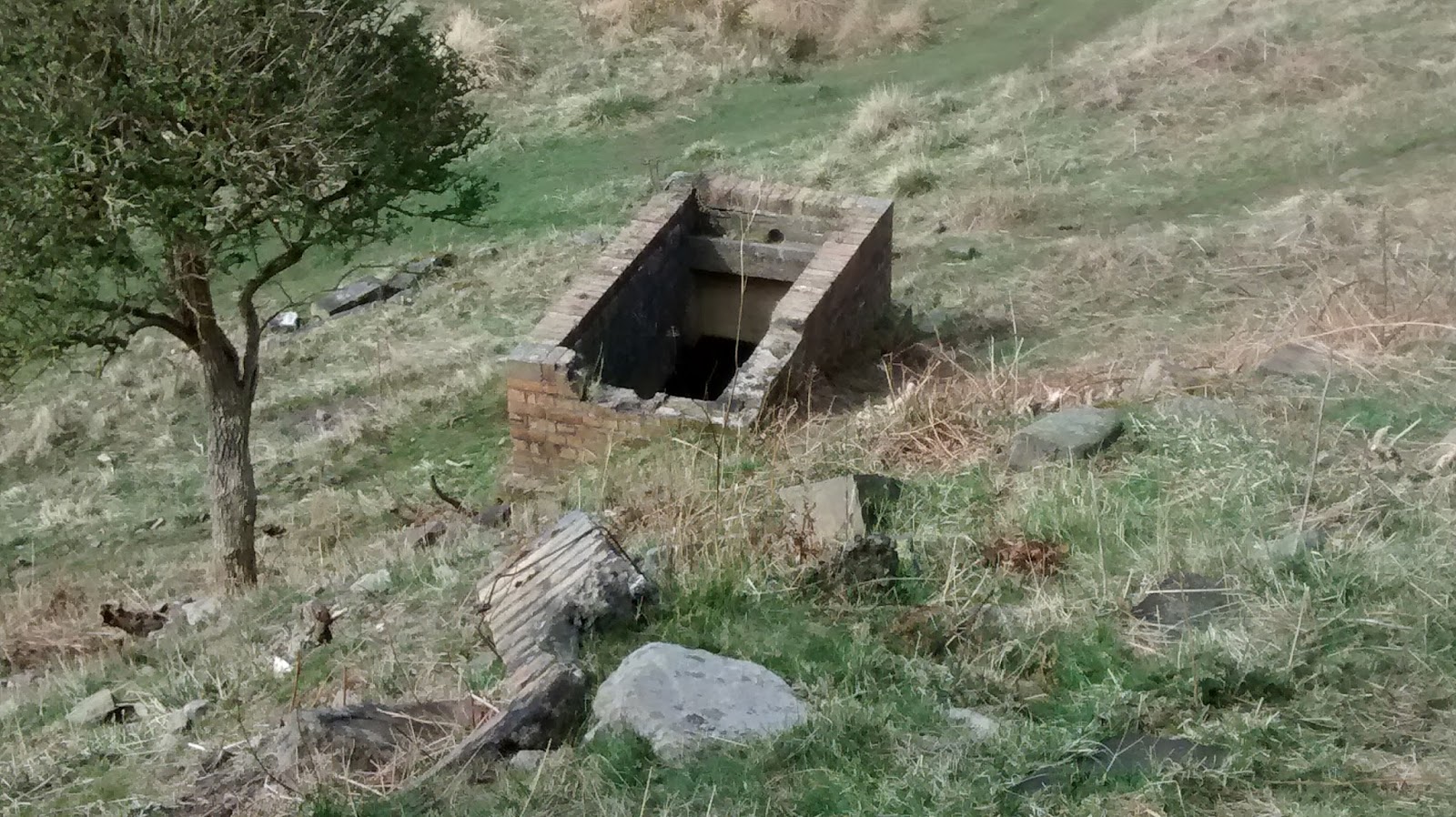
Structures and platforms adjacent to the main buildings. I don't think these are normally visible but some vegetation seems to have been cleared as of April 2015 when these were taken.There are basic platforms on the western side of the Heugh and only a little south-west of the main buildings.According to the Derelict Places website  they are mostly the bases for Nissen huts.This would presumably be for the staff though local stories have it that Italian POWs lived here.

Platform visible half way up side of Heugh


What appears to be a path-quite steep-marked by stones on Heugh side 


Platform at top

THE LILBURN TOWER-AT DUNSTANBURGH

The Lilburn Tower at Dunstanburgh. Nov 2012
Taken after very heavy rain which caused the northernmostmere to flood. This can be seen lower left of the composition.

Friday, 22 May 2015

Thursday, 7 May 2015

BERWICK'S BURRELL


I had a visit to Berwick last week, during the last days of the exhibition, to see the artworks which Sir William Burrell gifted to the town. The other Burrell Collection. I had seen the paintings as a child when they were  displayed  in the old library.

 I knew there would be Crawhalls. That was sufficient reason to go. And there were two watercolours by Arthur Melville*. Now I yield to none in my admiration for Melville and Crawhall.But both artists were represented by second grade work. To see those  four pictures by Crawhall was to think that  Burrell was giving Berwick less good examples. The Crawhall masterpieces, of which Burrell had many, went to Glasgow.The Daubigny is nothing special and the Gericault drawing-if it is by Gericault is not up to much.

In terms of quality,the best works-showing a good artist working well-were by Boudin, particularly the scene on the River Toques which flows into the sea between Deauville and Trouville, which you can see below.

Boudin; River Touques, Berwick Museum & Art Gallery
 It is a slightly odd collection, an Opie portrait and a portrait which was once given to Raeburn.And yet another LeNain group. There are several items by well known C19 Dutch artists-very much collected in late C19 Scotland. They are not very exciting examples of their work.

The dramatic and stagey Rembrandtesque landscape by Georges Michel is  hard to forget-but then he did churn them out.

The Degas sketch of Russian dancers was an indifferent example from a group of late works. Still it is always good to see a Degas.

I will not say anything about the examples of decorative art such as the Islamic tiles,the oriental ceramics, the metalwork and woodcarving which are beyond my expertise. Why Burrell gave these secondary items to Berwick could have many explanations. There wasn't an actual art gallery in Berwick and that may have influenced him as much as anything else.

Burrell was quite rightly, extremely concerned for the protection of the collection which became the eponymous museum -and expected it to be preserved in a suitably cautious manner. Glasgow has taken legal steps  twice to overturn clauses in his will: Firstly because his concerns had led him to stipulate a site at considerable distance from the centre of Glasgow (away from smoky shipyards).The second time, much more recently and frivolously was because Glasgow wants to send items from his collection on loan overseas.They got their way in the end. For more on this controversy see here.

*If you want to see really fine work by Melville then go to Edinburgh later this year for a real treat. Further info about the show at the National Gallery is here

Sunday, 19 April 2015

APPLEBYS IS CLOSING


The end of an era.Appleby's bookshop in Morpeth will soon be closing. It was my first bookshop.I remember one of my first books was Lawrence Durrell's "Bitter Lemons" about Cyprus. I never read anything more by him. I also bought, for 10/6d in 1965 John Rewald's biography of Cezanne which I read very quickly and then followed up with attempts to do Cezanne like watercolours.
This was before the Wallace family took over. In their time the shop seemed to expand a bit-onto the first floor. They eventually brought over container loads of books from the USA so it was a wonderful place to find art catalogues.
On the rare occasions when I bought a new book Appleby's could be much quicker in getting it than any high street chain.
There is now I think only one independent bookshop selling new books in Northumberland.That is 25 miles away in Hexham.Looking North-as I frequently do the next independent is at Newton St Boswells-which is into the Borders past Jedburgh.

Sunday, 19 October 2014

WRECKERS OF NORTHUMBERLAND

THe Wreckers-J M W Turner

This oil painting by Turner is in the collection of the Yale Center for British Art. It might be seen as a pictorial libel of the good fisher folk of Craster for Northumberland does have a fine record in terms of life-saving. The Boulmer lifeboat service was founded in 1825, in the decade before this painting was made.There was a life boat at Blyth from 1808 and Grace Darling  was to perform her epic rescue in 1838. So perhaps Turner's painting is a little anachronistic and may not quite quite match the facts as known.

But then again there were  supposedly two kinds of wreckers.The idea of wreckers as people who lure ships to destruction seems to have much less credibility than the idea that folk would take the cargo and anything else they could get from wrecked ships. Just what Turner was intending in this picture is not entirely clear .The group on the seashore appear to be hauling something  to land.The temptation to collect something useful must have been considerable and it is likely that country folk regarded this activity as on a par with poaching.

Turner had first visited Dunstanburgh in 1797 and here interprets the scene with considerable freedom. He has the relationship of the main towers to each other but forgets that the keep is not perched over a precipitous drop. He is perfectly correct that there is a considerable drop from the base of the   Lilburn tower to the top of  the Egyncleugh tower tower-a fact which many artists get wrong.

You can see several of Turner's paintings of Dunstanburgh in David Hill's Turner in the North published by Yale in 1997. Hill illustrates a Dunstanburgh from c 1828 which shows a customs officer arriving to supervise the salvage of a wreck.This watercolour is in the Manchester City Art Gallery.

Monday, 6 October 2014

An Optical Illusion at Dunstanburgh

I often visit Craster and the area round about. It is one of my favourite places. Dunstanburgh interests me from the point of Northumbrian history and as an artist I love the play of light on the castle ruins and the constantly changing colours of the bracken and grass through the seasons.I have explored the area a lot as a landscape painter and from one point up on the heugh you can see an example of a classic optical illusion.
Dunstanburgh from the Heugh
When  you look at the horizon in this photo above  I believe that you will see that on the right the horizon appears to be somewhat higher than it does on the left of the picture. This isn't really the case as you can see where I have superimposed a grey  layer on the second picture with a  straight line running along the horizon.


And another view where the illusion is even more obvious.


The illusion is  presumably caused because our eyes/ brain is disturbed by the mass of the castle in the centre of the picture and cannot, so to speak, join the two parts of the horizon line. On the left there is the steep fall of the land below the Lilburn tower  which, I would say, adds to the confusion. The silhouette of the castle itself may be an additional difficulty.

The bent or broken line illusion was discovered in the 1860s by JC Poggendorf a physicist. You can learn more about this illusion here and in this PDF